
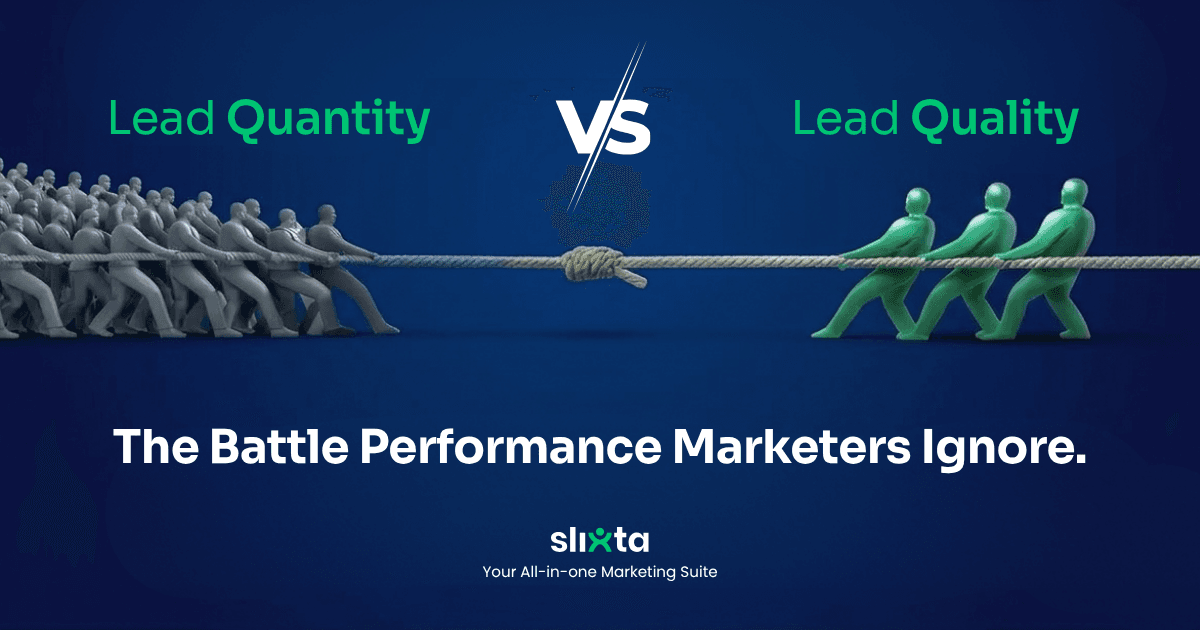
Lead Quality vs Lead Quantity. The Battle Performance Marketers Ignore
Feb 16, 2026
High lead numbers may look good on reports, but poor quality slows sales and wastes spend. Strong marketing focuses on attracting leads that are more likely to convert, not just increasing volume.
Toyota and Tesla didn’t just build successful car companies.
They built two completely different demand systems.
Toyota optimized for scale, building a system that could serve the widest possible market through operational efficiency and accessibility. Tesla, in contrast, built a brand and product ecosystem that naturally filtered demand, attracting buyers who already shared a specific level of intent.
These two companies represent something deeper than just different automotive strategies. They illustrate the same tension that exists in modern digital marketing.
Some growth systems prioritize lead quantity.
Others prioritize lead quality.
Understanding how these two forces interact is where an effective marketing strategy truly begins.
Efficiency vs Effectiveness in Lead Generation
As Peter Drucker said:
“Efficiency is doing things right; effectiveness is doing the right things.”
In the context of lead generation:
- Efficiency is about quantity.
It focuses on generating more leads at lower cost - optimizing CPL, reducing CPC, increasing form fills, and improving campaign scale. - Effectiveness is about quality.
It focuses on generating leads that convert - improving sales acceptance rates, deal value, retention, and revenue contribution.
An efficient campaign increases the number of leads entering the funnel. An effective campaign increases the number of leads moving through the funnel.
Efficiency strengthens acquisition metrics. Effectiveness strengthens revenue metrics.
For digital marketing teams and entrepreneurs, understanding this distinction is critical:
Quantity should be prioritized when:
- You’re in Testing or Scaling Mode: Digital campaigns require data density. More leads mean better audience insights, faster optimization, and clearer performance signals.
- Your Funnel Is Automated: If nurturing is handled by email flows, remarketing, or AI-driven scoring, volume fuels the system.
- You Operate in Low-Ticket or D2C Markets: Impulse-driven or lower-consideration products benefit from reach and frequency.
- Brand Awareness Is the Goal: Top-of-funnel growth depends on visibility before refinement.
In these scenarios, efficiency accelerates growth
Quality becomes the strategic focus when:
- You Have a High-Ticket or Long Sales Cycle: B2B, SaaS, consulting, or premium services require intent-driven leads. Volume without qualification strains sales resources.
- Sales Bandwidth Is Limited: If each lead requires manual follow-up, qualification becomes essential.
- Conversion Rate Is the Bottleneck: If traffic is high but revenue is stagnant, the issue is likely lead intent not volume.
- Customer Lifetime Value (LTV) Matters: Not all customers contribute equally. Higher-quality leads typically result in higher retention and upsell potential.
The Pareto Principle: Why Lead Prioritization Matters
Most growth systems eventually reveal a familiar pattern: a small portion of leads tends to generate the majority of revenue. This dynamic is often described through the Pareto Principle, where roughly 20 percent of inputs drive a disproportionate share of outcomes.
In marketing, this rarely means the remaining leads have no value. They contribute data, brand reach, and future opportunities. Quantity builds the surface area of the market.
The challenge appears when every lead is treated with the same urgency.
When high-intent prospects are mixed with early-stage explorers and routed through identical workflows, sales attention becomes evenly distributed instead of strategically focused. Teams spend valuable time qualifying rather than advancing conversations that are already ready to move forward.
The result is subtle but costly. Lead volume may continue to rise, dashboards may show healthy acquisition metrics, yet revenue efficiency does not improve at the same pace.
This is not a volume problem.
It is a prioritization problem.
Designing a System That Recognizes Intent Early
Generating leads is easy. Recognizing intent is hard.
Most organizations already have the necessary tools - advertising platforms, lead forms, messaging channels, and CRMs. Each captures a fragment of the customer journey, but rarely the full picture.
Intent signals appear constantly: a user clicking a high-intent campaign, asking a pricing question, or returning to the site multiple times. When these signals remain scattered across systems, sales teams are forced to treat every lead the same.
The result is predictable: slower responses, repeated qualification, and lost momentum.
Building a system that recognizes intent early requires three capabilities:
Capturing Behavioral Signals
Modern lead generation is less about collecting contact information and more about observing behavior. Engagement depth, the type of questions a prospect asks, or how frequently they return often reveal far more about intent than a simple form submission.
Intelligent Routing Through ICP and ABM
Once intent signals appear, they need to reach the right teams quickly. Aligning leads with the Ideal Customer Profile (ICP) and applying Account-Based Marketing principles ensures high-value prospects are prioritized instead of getting lost in general lead queues.
Speed Before Intent Decays
Intent has a short half-life. The longer the gap between interest and response, the lower the chance of conversion. Systems that connect campaigns, conversations, and lead data in real time can dramatically reduce this delay.
Platforms like Slixta are built around this exact structure.
By connecting advertising campaigns, conversational channels, and lead routing into a unified flow, Slixta helps capture behavioral signals the moment they occur. Those signals are then matched against ICP logic and routed using ABM-style prioritization, ensuring the right prospects reach the right teams instantly. Because the system operates in real time, conversations can begin while intent is still active.
Instead of forcing marketing teams to choose between scaling quantity and protecting quality, the infrastructure allows both to work together.
The Future Belongs to Structured Growth
The future of digital marketing will not belong to companies that generate the most leads, nor to those that focus only on a narrow set of “perfect” prospects.
The real advantage will belong to teams that design systems where quantity and quality work together.
Volume creates opportunity. Quality determines which opportunities become revenue.
As acquisition channels become easier to scale, generating leads will no longer be the hardest part of growth. The real challenge will be ensuring that the right leads are recognized quickly, prioritized correctly, and moved through the funnel without friction.
This is where infrastructure becomes critical.
Slixta is designed to support both sides of growth. It helps teams scale lead quantity through connected campaign flows while ensuring that lead quality is not lost along the way. By linking campaigns, conversations, and routing logic, Slixta allows high-intent prospects to surface quickly and reach the right teams with the right context.
Instead of forcing businesses to choose between reach and relevance, the system enables both.
More leads can fill your pipeline.
But only the right leads build your business