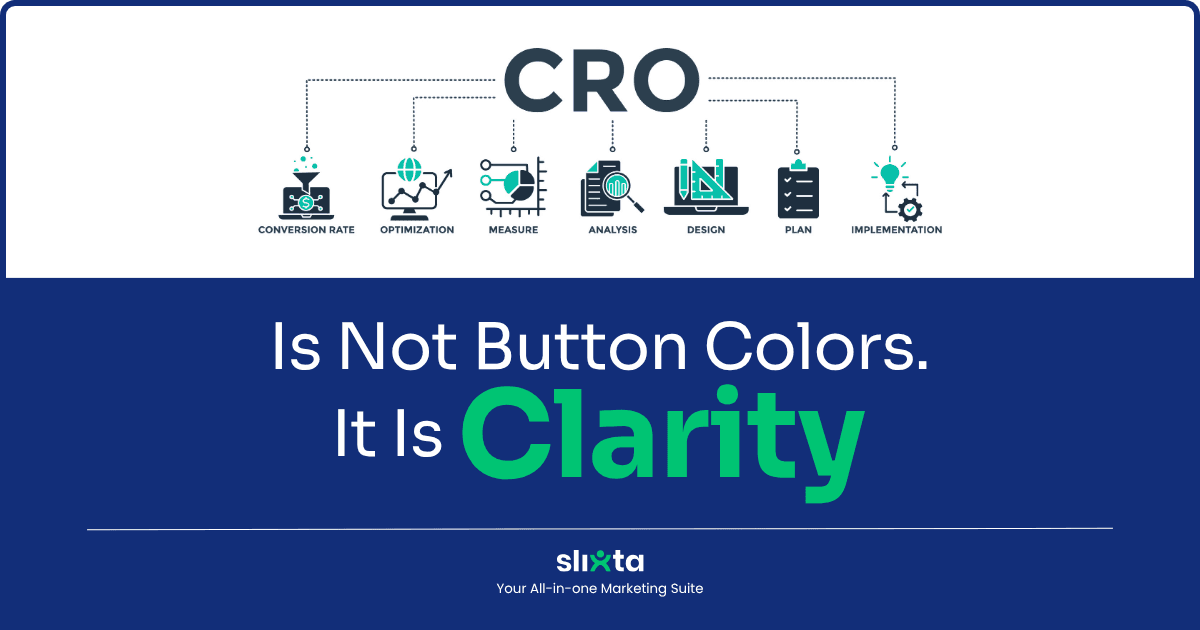
Conversions drop not because of design choices but because of uncertainty. Clear journeys, defined next steps, and reduced friction help users move forward with confidence.
In the world of digital marketing, we often treat CRO (Conversion Rate Optimization) as a high-tech game of "Spot the Difference." Conversion Rate Optimization is the systematic process of increasing the percentage of website visitors who take a specific action, whether that’s filling out a form, signing up for a newsletter, or making a purchase. However, CRO conversations start and end with surface-level aesthetics: testing a green button versus a red one, or moving a Call-to-Action (CTA) two inches higher on the page.
While small experiments matter, they are rarely the solution to the core issue. Users do not hesitate to click because of a specific shade of blue; they hesitate because of uncertainty.
The Friction of the Unknown: Addressing the Psychology of Hesitation
To solve for uncertainty, we must move beyond decoration and address the psychological friction that stops a visitor in their tracks. In behavioral economics, this is known as Cognitive Friction - the mental effort required to process a task or make a decision. When friction is high, the brain’s default response is "no."
Uncertainty is the primary driver of this friction. When a visitor lands on your page, they are conducting a subconscious risk assessment. They aren't looking at your button’s drop shadow; they are looking for answers to "The Three Pillars of User Anxiety":
- Process Ambiguity: Does the user know exactly what happens the millisecond after they click? If you don't explain that they will receive a WhatsApp message in 2 minutes, they assume their data is going into a "black hole".
- Information Gaps: Uncertainty spikes when there is a lack of Message Alignment. If an ad promises "Instant Pricing" but the page only says "Contact Us," the visitor senses a bait-and-switch and pulls back.
- Complexity Fatigue: Too many steps or unnecessary form fields trigger immediate fatigue. Each extra requirement is a micro-moment where the user reassesses if the reward is worth the effort. By streamlining the architecture to the path of least resistance, you move away from manual "Firefighting" and create a flow that feels natural and automated.
Real CRO isn't about making the page look better; it is a relentless pursuit of Clarity. It is about removing the "Chaos Tax" of a confusing journey so that the decision to convert becomes the path of least resistance
Conversion Gaps Often Appear Between Steps
Many teams evaluate conversion performance page by page.But visitors experience conversion as a sequence.
They move from an entry point to a page, from a page to a form, and from a form to a response. Most hesitation does not come from what they see inside a step. It comes from what they cannot see between steps.
High-performing journeys reduce this uncertainty by making progress visible. They signal what happens next, how quickly it happens, and where the interaction is moving. Instead of asking visitors to interpret the process themselves, the journey guides them forward.
This is where conversion optimization becomes more than page design. It becomes journey design.
And when journeys are structured clearly from first click to follow-up, the next step stops feeling like a decision and starts feeling like continuation which is exactly where connected execution systems begin to matter.
When CRO Misreads Performance
One of the biggest risks in conversion optimization is treating it as a page-level activity instead of a journey-level one.
When clarity is missing across the journey, teams often misinterpret what is actually happening inside campaigns. Strong interest can look like weak intent. Good traffic can appear inconsistent. Follow-ups may feel slower than they are simply because expectations were never defined at the point of entry.
This creates a measurement problem as much as a conversion problem.
Marketing teams start optimising headlines instead of improving transitions. Sales teams receive conversations without context. Campaign performance gets evaluated on clicks rather than progression.
Over time, optimisation effort moves toward what is easiest to change instead of what improves movement.
Where Structured Journeys Make Clarity Practical
Clarity in CRO is not only created through better messaging. It is created when the journey itself behaves predictably.
Visitors respond more confidently when the transition between steps is visible, when responses feel connected to the action they just took, and when campaigns move people forward without requiring interpretation at every stage.
This is where platforms like Slixta strengthen conversion journeys in a practical way.
By keeping pages, forms, routing logic, and conversations connected, Slixta helps ensure that the next step after submission feels immediate and intentional rather than uncertain. Marketing teams gain better visibility into how interest moves forward. Sales teams receive interactions with clearer context. And campaign performance becomes easier to improve because movement across steps is structured instead of fragmented.
Slixta supports structured journeys that make the next step obvious and immediate.
Because clarity converts better than decoration