
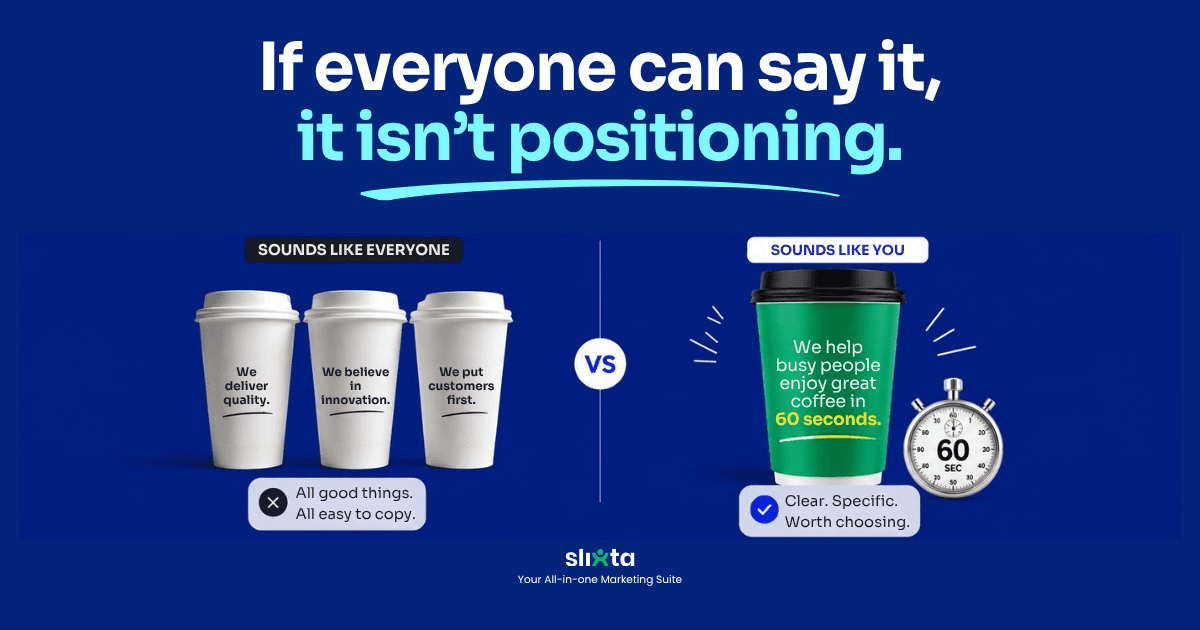
Generic claims like "quality" and "customer-first" rarely make a brand stand out. Learn why specific promises work better, how they pre-qualify your audience, and why that message needs to stay consistent from the ad to the conversion.
In 1962, Avis was losing money.
They were number two in car rentals, behind Hertz, with no obvious route to closing the gap. Their agency suggested something that sounded like a terrible idea: admit it publicly.
The campaign they ran said: "We're only No. 2. We try harder."
It became one of the most effective advertising campaigns in history. Not because it was clever. Because it was specific. Nobody else could say it. It was true only of Avis, at that moment, in that market. And because it was specific, it was believable. And because it was believable, it worked.
Most businesses are doing the exact opposite.
If Everyone Can Say It, It Isn't Positioning
Somewhere along the way, business communication learned a set of words that felt safe.
Quality. Innovation. Customer-first. Trusted. Passionate. Excellence.
These words appear on websites, in pitch decks, in LinkedIn bios, and across thousands of ads every single day. They feel substantial when you write them. They are completely invisible to the person reading them.
The problem is not that they are bad values. The problem is that they are costless claims. Anyone can say them. Your competitor can copy every one of them by tomorrow morning without lying. And when a claim costs nothing to make, it carries nothing in the mind of the person receiving it.
In the 1980s, Al Ries and Jack Trout wrote what remains the most important book on this subject. Their argument in Positioning was simple: the battle for the customer is not fought in the market. It is fought in the mind. And the mind, already overwhelmed with information, makes room only for ideas that are clear, specific, and distinct.
A generic claim gives the mind nothing to hold onto.
What Specificity Actually Does
Specificity does three things that vague positioning cannot.
It creates instant clarity. "We help busy professionals find the right health insurance in under ten minutes" tells you immediately who it is for, what it does, and why it matters. You do not have to infer anything. The claim does the work.
It builds credibility automatically. Specific claims feel earned. A business confident enough to say exactly who it serves and exactly what it delivers is implicitly signalling that it has actually done it. Vague claims signal the opposite: that no specific promise can be safely made.
It makes the choice easier. When a potential customer is comparing three options, two of which say "we deliver quality solutions" and one of which says "we cut small business accounting time by half," the choice is not actually a choice. One option answered the question. The others did not.
Rosser Reeves, one of the foundational thinkers in advertising, called this the Unique Selling Proposition. His argument was precise: every ad must make a specific proposition, one the competition either cannot or does not make, and it must be strong enough that someone who reads it remembers it and repeats it.
Three conditions. A concrete benefit, not a description. A claim nobody else has planted their flag on. And something strong enough to actually move a person, not just inform them.
Most positioning today fails the first test before it reaches the second or third. It describes rather than promises. And descriptions, no matter how well written, do not move people.
The Three Questions That Force Specificity
Most positioning problems are actually clarity problems. The business knows what it does but has never been forced to answer the questions that make it specific.
Who exactly is this for. Not "businesses" or "people who need our service." The more precisely you can describe the person who benefits most, the more that person will feel the communication was written for them.
What do you do particularly well. Not everything. The one thing that, if you removed it, would make your business genuinely worse than an alternative. That thing deserves to be in the headline.
Why should someone care right now. Benefit, not feature. Not what it is, but what changes for the customer because of it.
Answering these three questions narrows the claim. And narrowing the claim is the work. A statement like "We help busy people enjoy great coffee in 60 seconds" passes all three tests. You know who it is for. You know what the product does. You know why it matters. It is not trying to speak to everyone. Which is exactly why it speaks clearly to someone.
Why This Matters Most in Ads
In a piece of content, vague positioning is a problem. In an ad, it is fatal.
An ad has three seconds. Sometimes fewer. The person seeing it did not ask to see it and has no patience for a claim that requires interpretation. If the message does not land immediately and specifically, the thumb moves and the impression is gone.
There is also a mechanical dimension to this that most advertisers overlook.Specific ads attract the right people and repel the wrong people. That improves the quality of the response you're getting. An ad making a specific claim to a specific audience tends to perform better on every metric the platform optimises for, because the right people are stopping and the wrong people are moving on.The brands that consistently outperform in paid advertising are not the ones with the largest budgets. They are the ones whose message is specific enough to make the right person stop. A specific claim pre-qualifies the audience by design. The people who resonate with it lean in. The people it is not for keep scrolling. That self-selection is not a loss. It is the system working.
Specificity in ads also creates a consistency problem that most businesses have not solved. When the ad makes a specific promise, the landing page has to keep it. The follow-up has to reinforce it. If the ad says one thing and the page says something generic, the trust built in three seconds is undone in the next ten.
Specificity shouldn't stop at the ad. It should survive the entire funnel.This is where Slixta connects the specificity to the outcome. When the ad, the landing page, and the follow-up sequence live inside the same system, the specific message the visitor responded to travels with them. The follow-up knows what they clicked on. The content they see next matches what they were promised. The chain does not break between the ad and the conversion.
The ad makes a promise. The landing page confirms it. The follow-up continues it. If the message changes at every step, specificity becomes wasted effort.
The Lesson From Avis
Avis did not win because they found better words.
They won because they told a specific truth that nobody else could tell. They made a claim so precise that it excluded everyone except them, and in doing so, made themselves unforgettable.
Most businesses are trying to sound like the best option for everyone.
The ones that grow are usually the ones willing to be the obvious choice for someone specific.
Start there.